


Japanese used cars are among the most sought-after vehicles for export thanks to their reliability, careful maintenance, and competitive prices at Japanese car auctions. If you are researching Japanese car auctions, used cars from Japan or the best Japanese cars to import, this guide looks at seven markets: Uganda, Kenya, Tanzania, Zambia, Australia, New Zealand and the United Kingdom. Whether you are importing for personal use or resale, thousands of cars pass through Japanese car auction sites every week, from budget hatchbacks to rare JDM legends.
- Introduction
- Most Popular Japanese Cars to Import to Uganda
- Best Japanese Cars to Import to Kenya
- Best Japanese Cars to Import to Tanzania
- Popular Japanese Cars Imported to Zambia
- Best JDM Cars to Import to Australia
- Most Popular Japanese Cars Imported to New Zealand
- Best Japanese Cars to Import to the United Kingdom
- Why Japanese Cars Are Popular Worldwide
- How to Import a Car from Japan (Step by Step)
- How to Buy Cars from Japanese Car Auctions Online
- Conclusion
Introduction
Japan is one of the world’s major sources of used cars for export. Because of the regular shaken roadworthiness inspections and a strong maintenance culture, many used cars from Japan are well looked after, and cars sold at auction come with an auction inspection sheet. Through an exporter who is a member of Japanese dealer-only auctions, you can buy close to the source instead of paying for several middlemen.
The model lists below are not sales statistics. They are models worth considering for each market, chosen for local roads, fuel costs, parts supply and import rules. Before you choose a car, check the import rules of your country: the most important ones are noted in each section, with official sources at the end of the article.

Most Popular Japanese Cars to Import to Uganda
Ugandan buyers often look for comfortable crossovers and sedans that can handle rough roads yet remain affordable to maintain.
Check first: Uganda prohibits imports of passenger cars aged 15 years or more, counting from the year of manufacture, and cars aged 9 to under 15 years attract an environmental levy of 50% of the CIF value. A car under 9 years old avoids that levy.
Models worth considering for Uganda:
- Toyota Harrier
- Toyota Premio
- Toyota Corolla
- Toyota Noah
- Toyota Wish
- Subaru Forester
- Toyota RAV4
- Toyota Vanguard
- Nissan X-Trail
- Honda Fit
Why these models suit Uganda:
- Suspension and ground clearance that cope with rough and unpaved roads.
- Reliable engines with a long lifespan when serviced correctly.
- Affordable maintenance and widely available spare parts.

Best Japanese Cars to Import to Kenya
Kenya has a very active market for cars from Japanese car auctions online, especially compact, fuel‑efficient models that perform well in city traffic.
Check first: Kenya does not allow imports of used cars older than 8 years or of left-hand-drive cars (except special-purpose vehicles). Import duty, excise and VAT add a large share to the price, so compare the full landed cost, not only the auction price.
Models worth considering for Kenya:
- Toyota Fielder
- Toyota Axio
- Toyota Probox
- Nissan Note
- Toyota Yaris
- Mazda Demio
- Honda Fit
- Toyota Hiace
- Toyota Land Cruiser Prado
- Toyota Harrier
Why these models suit Kenya:
- Good fuel economy for daily commuting and rideshare work.
- Wide availability of spare parts and mechanics familiar with Japanese models.
- Proven reliability for daily driving in both city and rural conditions.
- Models that are well known on the local market are easier to resell.

Best Japanese Cars to Import to Tanzania
Many Tanzanian buyers look for SUVs and crossovers that handle mixed terrain and long distances.
Check first: in mainland Tanzania, excise duty rises sharply with age: on top of the standard rate, used cars aged 8–10 years attract a further 18%, cars over 10 and up to 20 years 35%, and cars over 20 years 40%. Used cars from Japan must also be inspected before shipment by the company appointed by the Tanzania Bureau of Standards (TBS).
Models worth considering for Tanzania:
- Toyota Harrier
- Toyota Land Cruiser Prado
- Toyota RAV4
- Toyota Vanguard
- Nissan X-Trail
- Toyota Premio
- Toyota Mark X
- Toyota Corolla
- Honda Fit
- Mazda Demio
Why these models suit Tanzania:
- Crossovers and SUVs provide ground clearance for rural and off‑road use.
- Sedans like the Mark X and the Premio balance comfort, performance and style.
- Japanese engines remain reliable in hot climates when properly maintained.
Popular Japanese Cars Imported to Zambia
Zambian buyers value both durable work vehicles and comfortable daily drivers from Japanese car auction sites.
Check first: Zambia has no hard age limit, but charges a fixed surtax of ZMW 2,000 on each imported passenger car over 5 years old, and only right-hand-drive cars are permitted.
Models worth considering for Zambia:
- Toyota Corolla
- Toyota Mark X
- Toyota Harrier
- Toyota RAV4
- Nissan X-Trail
- Honda Fit
- Mazda Demio
- Toyota Hilux
- Toyota Land Cruiser Prado
- Nissan Dualis
Why these models suit Zambia:
- A mix of compact cars, crossovers and pickups for both family and business use.
- A strong reputation for reliability in mining areas, on farms and in growing cities.
- The Toyota Hilux and Land Cruiser Prado are trusted for commercial and off‑road tasks.
Best JDM Cars to Import to Australia
Australia has a strong JDM car culture, and many enthusiasts rely on JDM auctions and Japan car auction live access to source rare performance models.
Check first: Australia is strict about which cars can be imported. Cars at least 25 years old can apply for a concessional entry on the Register of Approved Vehicles (RAV). Newer cars generally need to qualify as specialist and enthusiast vehicles (SEVs), which is mostly limited to models or variants that were not sold new in Australia. That is why recent models such as the Toyota GR Yaris, GR Corolla or the current Supra, which are sold new in Australia, are usually not an option for a private import.
Models worth considering for Australia (versions built at least 25 years ago):
- Nissan Skyline (R32, R33)
- Nissan Silvia (S13, S14)
- Toyota Chaser (JZX90, JZX100)
- Toyota Supra (A80)
- Mitsubishi Lancer Evolution (early generations)
- Subaru Impreza WRX STI (GC8)
- Honda Integra Type R (DC2)
- Mazda RX-7 (FD)
- Toyota Celica (older generations)
Why these JDM cars are popular in Australia:
- Deep JDM culture, active car clubs and track-day events across the country.
- Strong interest in high‑performance Japanese sports cars, including versions never sold locally.
- Classic models from the 1990s are now old enough for the 25-year route.

Most Popular Japanese Cars Imported to New Zealand
New Zealand imports many fuel‑efficient hybrids and compact cars from Japanese car auctions in Japan.
Check first: imported used cars must pass entry certification before they can be registered, and importers of light vehicles must comply with the Clean Car Standard, which applies a charge or a credit depending on the car’s CO₂ emissions. Low-emission hybrids and electric cars come out better under this scheme.
Models worth considering for New Zealand:
- Toyota Aqua
- Toyota Prius
- Mazda Axela
- Nissan Leaf
- Honda Fit
- Toyota Corolla
- Subaru Impreza
- Toyota Vitz
- Mazda Demio
- Toyota Camry
Why these models suit New Zealand:
- Hybrid and electric models (Aqua, Prius, Leaf) help reduce running costs and emissions.
- Compact hatchbacks are practical for city driving and narrow streets.
- Japanese-market versions often come with good safety and comfort equipment.
Best Japanese Cars to Import to the United Kingdom
The UK has a strong community of JDM enthusiasts who regularly buy from JDM car auction platforms and Japanese import auctions.
Check first: a used car from Japan normally needs Individual Vehicle Approval (IVA) in Great Britain, but may be exempt if it was built or first registered more than 10 years ago. Budget for 10% customs duty and 20% import VAT.
Models worth considering for the United Kingdom:
- Nissan Skyline GT-R
- Toyota Supra
- Mazda RX-7
- Mitsubishi Lancer Evolution
- Subaru WRX STI
- Honda Integra Type R
- Toyota Chaser
- Nissan Silvia
- Toyota Alphard
- Nissan Elgrand
Why these cars are popular in the UK:
- High‑performance legends like the Skyline GT‑R, RX‑7 and Evo are icons of Japanese motorsport and tuning.
- MPVs such as the Toyota Alphard and Nissan Elgrand offer spacious, well-equipped interiors for families and private hire.
- Many of these models or versions were never officially sold in the UK, so importing is the way to own one. Older classics are also more likely to be exempt from IVA.

Why Japanese Cars Are Popular Worldwide
Japanese vehicles have built a reputation for reliability, fuel efficiency and long service life. Japan’s shaken roadworthiness inspections push owners to keep cars in good condition, and many cars are sold while still relatively young. For exporters and buyers, the Japanese car export market offers:
- Auction inspection sheets and grades for cars sold at auction.
- Competitive prices at dealer-only auctions compared with many local markets.
- A huge variety of models every week, from small kei cars to heavy-duty SUVs and trucks.
These advantages explain why so many Japanese vehicles on the roads of Nairobi, Kampala, Sydney, Auckland and London share the same origin: the Japanese auction lanes.
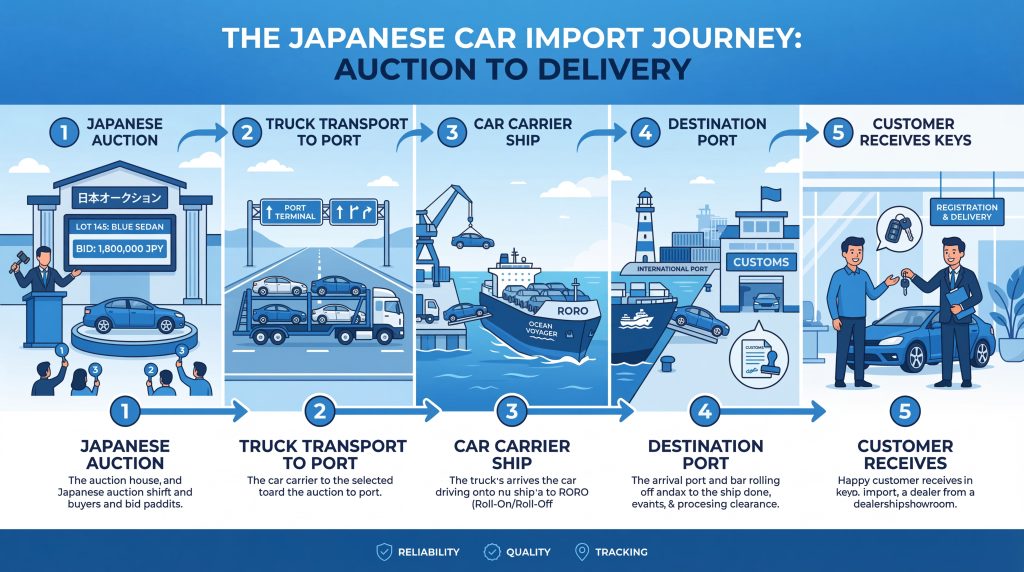
How to Import a Car from Japan (Step by Step)
If you are wondering how to import a car from Japan step by step, the process usually follows several clear stages.
1. Choose a car at a Japanese auction
- Work with an exporter who is a member of Japanese dealer-only auctions and gives you access to them online, including major auction groups like USS, TAA, JU, CAA and ARAI.
2. Check the auction inspection sheet
- Review the auction grade, mileage, repair history, interior and exterior condition, and any notes about previous accidents or corrosion.
3. Place a bid or use “buy now”
- Your exporter will submit bids on your behalf based on your maximum budget, including all fees.
4. Arrange inland transportation to the port
- After a successful bid, the car is transported from the auction site to the export port in Japan.
5. Prepare export documents
- The exporter handles deregistration, the export certificate and any required translations.
6. Ship the car to your country
- Choose RoRo (roll‑on/roll‑off) or container shipping depending on budget and vehicle type.
7. Complete import and registration in your country
- Pay import duties, taxes and port charges, then register the car according to local regulations.
Working with a reliable Japanese export company makes buying cars for sale in Japan auctions much safer and more transparent, especially for first‑time importers. For each stage in detail, see our guide How to Import a Car from Japan.
How to Buy Cars from Japanese Car Auctions Online
Japanese car auctions are the main source of used vehicles for export, with a large number of cars offered every week across several auction groups. Private buyers cannot bid at these dealer-only auctions themselves, which is why they work with exporters who are auction members and give access to Japanese car auction website platforms.
Key steps when buying from Japanese car auction sites:
- Register with an exporter
Agree the terms and provide your details so the exporter can bid on your behalf. - Browse live auction stock
Use search tools and auction car lists to check upcoming vehicles. - Request translations and additional photos
Your exporter can translate the auction sheet, send extra photos and, at some auction sites, inspect the car in person. - Use secure payment methods
Pay only to the exporter’s corporate bank account, as set out in the terms: usually a deposit before bidding and the balance after a successful bid. - Get your documents
After shipment, the exporter provides the Bill of Lading and the export documents your customs needs.
Whether you started by searching for “best Japanese car auction sites”, “best Japanese cars to import”, “buy car from Japan auction” or “buy used cars from Japan auction”, the safest route is the same: choose an exporter you can verify and let them manage the full process from auction to delivery.
Conclusion
From affordable compact cars for East Africa to rare JDM classics for Australia and the UK, Japanese car auctions give buyers around the world access to an enormous selection of vehicles. The right choice depends on your roads, fuel prices and, above all, your country’s import rules: a Toyota Probox for Kenya, a Toyota Aqua for New Zealand or a Nissan Skyline GT‑R for the United Kingdom.
With a trusted exporter, a clear understanding of the process, and smart use of Japanese car auction sites, importing a car directly from Japan in 2026 can be both cost‑effective and secure.
Sources (checked November 2026)
- Uganda: Uganda Revenue Authority, Import & Export FAQs
- Kenya: Kenya Revenue Authority, procedures for motor vehicle importation; KEBS, notice on left-hand-drive vehicles
- Tanzania: Finance Act 2026 (Tanzania Revenue Authority); TBS, appointed inspection agents for used vehicles
- Zambia: Zambia Revenue Authority, National Tariff Book (January 2026)
- Australia: Australian Government, concessional RAV entry approvals; Guide to specialist and enthusiast vehicles
- New Zealand: NZTA, used vehicles from Japan; NZTA, Clean Car Standard
- United Kingdom: GOV.UK, getting vehicle approval; GOV.UK, paying VAT and duty


