


- Introduction to Japanese Car Auctions
- How Japanese Car Auctions Work
- Understand the Auction Sheet
- Major Japanese Car Auction Houses
- Regional Car Auctions Across Japan
- Types of Vehicles Sold at Japanese Auctions
- What Makes Japanese Car Auctions Reliable
- Who Can Buy from Japanese Auctions
- Tips for Buying from Japanese Car Auctions
Introduction to Japanese Car Auctions
Japanese car auctions are wholesale, members-only markets. To join USS, Japan’s largest auction group, a company must be registered in Japan, hold a Japanese license to trade used vehicles and have full-time Japanese-speaking staff. Buyers outside Japan usually buy through a Japanese exporter with auction access. Auction sheets describe each car’s condition so members can assess vehicles before bidding remotely.
In 2025, Japanese auto auctions listed 8.0 million vehicles, and USS accounted for 43.2% of those listings. In the fiscal year ended March 2026, USS auctions offered 3.50 million vehicles and sold 2.35 million (67.0%).
Japan exported about 1.71 million used vehicles in 2025. Major destinations included the United Arab Emirates (about 253,000 vehicles), Russia (186,000) and Tanzania (118,000); Kenya took about 77,000.
Sources: USS Data Book 2026, pp. 3, 5 and 9; USS, Membership Information; USS, Types of Auto Auction. Checked 13 November 2026.
How Japanese Car Auctions Work
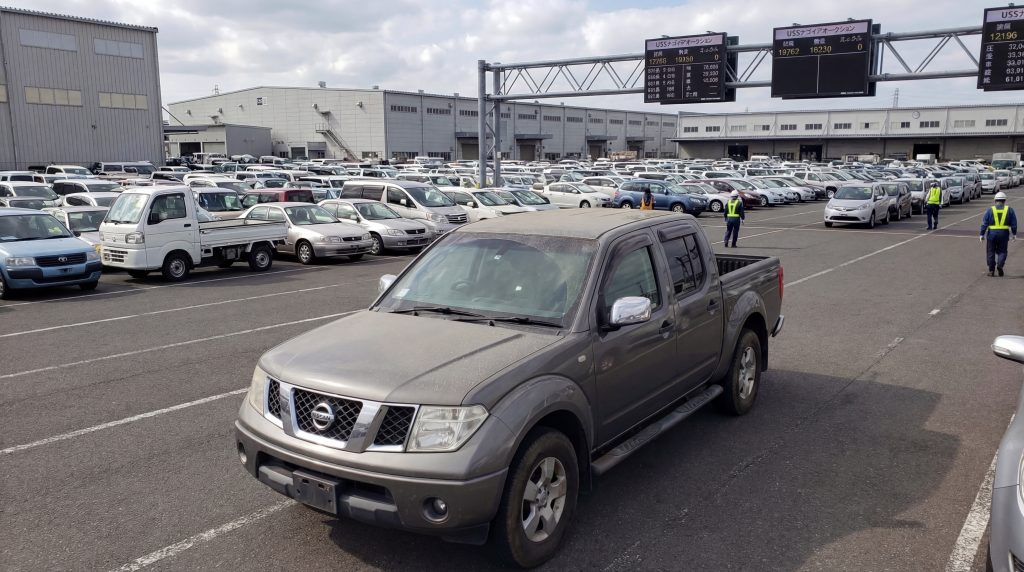
Only auction members can bid. The first five steps follow the process at USS, Japan’s largest auction group. The final step covers what happens when a car is bought for export.
Step 1. Deliver the car to the auction
The selling member arranges delivery to the auction site. USS asks sellers to have their cars on site by the morning of the day before the auction so the cars can be inspected and photographed before bidding begins.
Step 2. Inspect and grade the car
The seller provides the vehicle details, including the model, chassis number and mileage. A USS inspector checks for scratches and dents, examines the engine’s condition, and looks for signs of past accidents and repairs. The inspector records the findings and assigns a grade on USS’s 10-grade scale.
Read the grade together with the inspector’s notes and the damage marks on the body diagram. Grading systems vary by auction group. For examples, see Understand the Auction Sheet. The auction sheet is in Japanese; a DARIAL manager can translate it on request.
Step 3. Review the listing and inspect the car before bidding
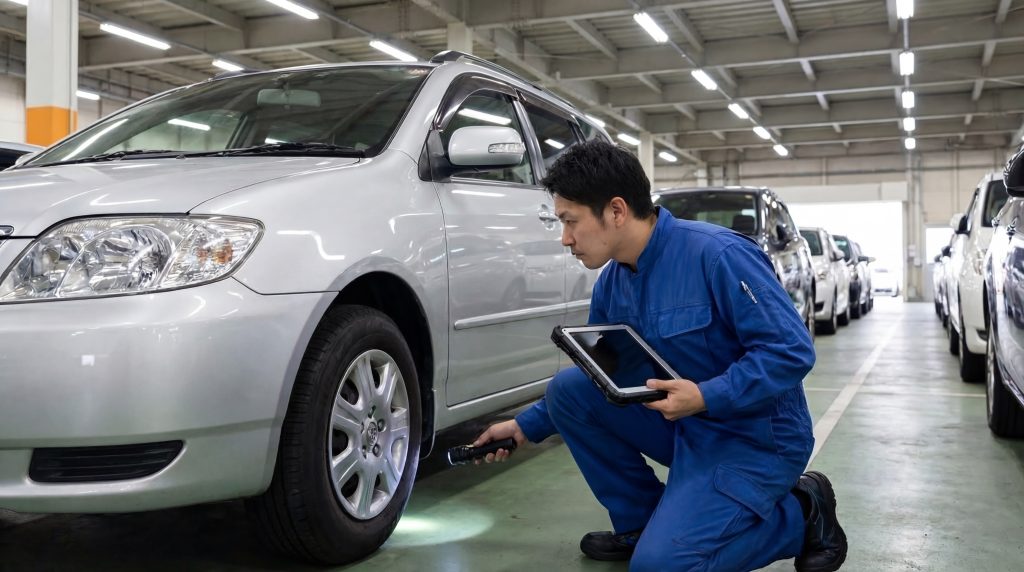
USS adds the photographs and inspection results to its database. Members can review the listing online or through a dedicated terminal. If a photograph or inspection note raises a question, a member can examine the car at the auction site before bidding. Members bidding remotely can request an on-site inspection through USS. At some auction sites, DARIAL can also inspect the car in person.
Step 4. Bid on the car
USS auctions run several lanes at once. The Tokyo site uses 16 lanes, and USS says a sale takes about 20 seconds per vehicle. Members can bid at the venue, through a USS JAPAN terminal or online in real time. On auction day, the seller can adjust the starting price and the price they are willing to accept.
Step 5. Collect the car and complete payment and paperwork
The winning member pays USS the vehicle price and the buyer’s auction fee. USS deducts the seller’s listing and sale fees before paying the seller. Once USS confirms payment, it passes the vehicle inspection certificate, ownership transfer certificate and seller’s seal certificate to the buying member. USS’s published timeline shows vehicle collection four days after the auction and completion of payment and paperwork within one week.
Step 6. Prepare the car for export and shipment
For a car still registered in Japan, the owner applies to the transport bureau for export deregistration. If the car has already been temporarily deregistered, the owner applies for a certificate of planned export. Either application can be made up to six months before the planned export date. The appropriate certificate is presented to Japan Customs for export clearance.
The destination may also require a separate inspection before shipment. A used car bound for Kenya, for example, must pass a roadworthiness inspection in Japan by an organization designated by the Kenya Bureau of Standards. The exporter pays the inspection fee.
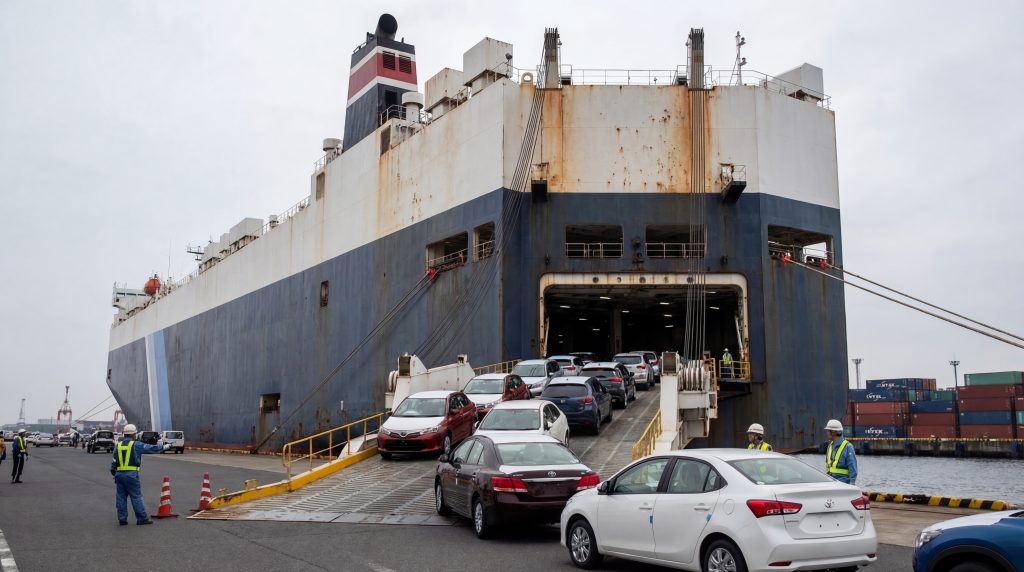
For sea transport, a car can be driven aboard a roll-on/roll-off (RoRo) vessel or loaded into a shipping container. The export paperwork includes a commercial invoice identifying the car by its chassis number. After loading, the shipping line issues the bill of lading.
Sources: USS, Steps in a USS Auto Auction; USS, Types of Auto Auction; USS, History; USS, Vehicle Inspection; USS, Vehicle Listing Rules; MLIT Tohoku District Transport Bureau, Export Deregistration and Notice of Planned Export; Japan Customs, Customs Procedures for Exporting Used Vehicles; JETRO, Documents and Procedures for Exporting Used Vehicles from Japan; JETRO, Used Vehicle Import Requirements for Kenya. Checked 13 November 2026.
Understand the Auction Sheet
Each car at a Japanese auction usually receives an overall grade plus separate interior and exterior grades. Scales differ between auction groups. The meanings below follow the JU auction inspection standard (中商連オートオークション検査基準), effective 1 April 2019. JU auctions are used-car auctions run by Japan’s prefectural used car dealers’ cooperatives (such as JU Tokyo) under their national federation, 日本中古自動車販売商工組合連合会 (中商連, Chushoren).
What do the overall grades on a Japanese auction sheet mean?
“S” — nearly new: up to 10,000 km and up to 12 months since first registration, interior and exterior in good condition.
“6” — up to 30,000 km and up to 36 months; minor scratches or dents that need no repair.
“5” — up to 50,000 km; defects that need only light repair.
“4.5” — up to 100,000 km; defects that need some repair.
“4” — up to 150,000 km; scratches, dents or rust that need repair, and visible repair traces.
“3.5” and “3” — defects that need repair; repair traces are somewhat rough (“3.5”) or rough (“3”).
“2” — needs overall repair, including rust and corrosion.
“1” — a flood-damaged car, or a car with traces of fire-extinguishing agent.
“R” — accident repair history (修復歴車): the car’s structural frame was damaged and repaired. At JU auctions, “R” also covers cars with unrepaired frame damage. “R1” means a car with frame damage history that is also flood-damaged or has traces of fire-extinguishing agent.
No grade (blank) — at JU auctions, a car in very poor condition or an accident-damaged car sold as-is that needs costly repair. At some other auctions, such cars are graded “0”.
“R” does not mean “rear damage”.
What do the interior and exterior grades mean?
Interior and exterior grades run from “A” (no repair needed) to “E” (difficult to restore).
What do the letters on the body diagram mean?
Letters on the body diagram are separate from the overall grade. At JU auctions, “A1–A4” mark scratches, “U1–U4” dents, “W1–W3” repair marks (from well finished to needing refinishing), “S1–S3” rust and “C1–C3” corrosion; “×” means a part needs replacement and “××” means it has been replaced. “S1–S3” on the body diagram means rust and has nothing to do with the overall grade “S”.
What does the auction inspection cover?
At JU auctions, the inspection covers only the interior, the exterior and accident history — not the engine or other mechanical functions. The auction sheet is reference information, not a quality guarantee.
Sources: JU auction inspection standard (中商連オートオークション検査基準), effective 1 April 2019. Checked 13 November 2026.
Major Japanese Car Auction Houses
In 2025, Japan’s four largest individual auction groups by share of vehicles listed were USS (43.2%), TAA (12.4%), CAA (5.7%) and Arai (5.6%). JU-affiliated venues together accounted for 17.1% of listings nationwide. That figure combines auctions run by separate prefectural cooperatives, so it falls outside the ranking of individual groups.
USS Auctions
USS runs weekly auctions across a network of 19 sites. Members can bid on site, through USS JAPAN terminals or online in real time. USS Tokyo was the group’s busiest venue, with 876,049 vehicles listed in the fiscal year ended March 2026. HAA Kobe and USS Kobe are separate venues within the USS network. HAA Kobe became part of USS through a merger in October 2021.
TAA (Toyota Auto Auction)
Toyota U-SEC operates 16 TAA venues across Japan. The company dates TAA to 1967, when it launched auctions in Tokyo, Osaka and Nagoya, and describes TAA as Japan’s first auto auction. TAA and CAA members can take part in each other’s auctions and bid online through their shared service, TC-webΣ.
CAA (Chubu Auto Auction)
Founded in 1987, CAA holds weekly auctions at four venues: Chubu, Tokyo, Gifu and Tohoku. CAA inspectors check each vehicle, and an automated system calculates its grade from their findings. Members can review the inspection results and vehicle photos online before bidding. CAA formed a capital and business alliance with Toyota Motor Corporation and Toyota U-SEC in 2005. Reciprocal membership with Toyota U-SEC began in 2006.
JU Auctions
Japan’s prefectural used-car dealer cooperatives run JU auctions under their national federation, Chushoren (日本中古自動車販売商工組合連合会). The organizing cooperative has each car inspected by a Chushoren-certified inspector. Venues include JU Sapporo in Hokkaido, JU Tokyo in Koshigaya, Saitama Prefecture, JU Aichi in Tobishima and JU Hiroshima in Kitahiroshima, Hiroshima Prefecture.
In 2025, JU-affiliated venues accounted for about 1.37 million listings, or 17.1% of the national total. The JU Gifu group alone accounted for 3.2% of national listings.
Arai Auction
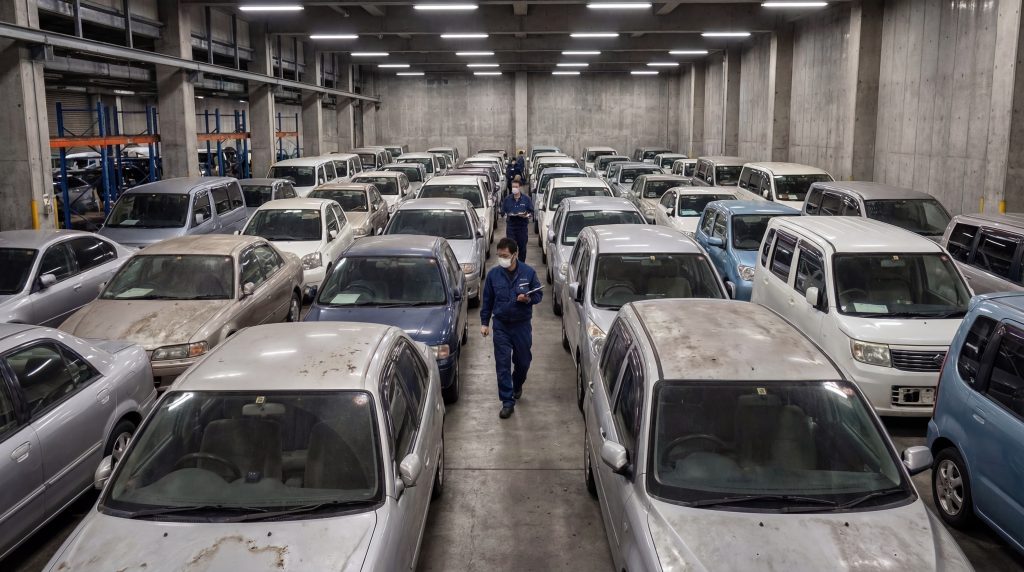
Arai Shoji Co., Ltd. runs auctions for passenger cars, vans, trucks, construction equipment and agricultural machinery. Its vehicle auction in Oyama, Tochigi Prefecture, opened in 1987. A dedicated van and truck auction followed there in 1989. Arai lists seven venues: Sendai, Oyama, Oyama General Machinery, Bayside, Nagoya, Kansai and Fukuoka.
Honda Auto Auction (Honda AA)
Honda Auto Auction lists six main venues: Hokkaido in Chitose, Sendai in Iwanuma, Tokyo in Tachikawa, Nagoya in Tokai, Kansai in Kobe and Kyushu in Chikugo. Honda AA Kansai and HAA Kobe are separate auctions in Kobe. Honda lists Kansai in its own network, while USS lists HAA Kobe among its venues.
Nissan Auto Auction (NAA)
Nissan Auto Auction lists four venues: NAA Tokyo in Yokohama, NAA Nagoya in Komaki, NAA Osaka in Settsu and NAA Fukuoka in Hisayama.
Sources: USS Data Book 2026, pp. 4, 5 and 9; USS, Types of Auto Auction; USS, History; Toyota U-SEC, Auto Auction; Toyota U-SEC, History; TC-webΣ; CAA, About Auto Auctions; CAA, History; JU Tokyo, Chushoren Auto Auction Inspection Standards; JU Navi and JU Trade, Participating Venues; Arai Auction, Company Overview; Arai Auction, History and Venues; Honda Auto Auction, Business Overview; Nissan Auto Auction, Venue Guide. Checked 13 November 2026.
Regional Car Auctions Across Japan
Auction names do not always tell you where the cars are. The five “Tokyo” venues below are in five different cities: USS Tokyo in Noda, CAA Tokyo in Kashiwa, Honda AA Tokyo in Tachikawa, NAA Tokyo in Yokohama and JU Tokyo in Koshigaya.
Hokkaido and Tohoku. In Hokkaido, USS Sapporo is in Ebetsu, JU Sapporo is in Sapporo, and TAA Hokkaido and Honda AA Hokkaido are both in Chitose. In Tohoku, Miyagi Prefecture has USS Tohoku in Murata, Honda AA Sendai in Iwanuma and Arai Sendai. TAA Tohoku is in Koriyama, Fukushima, and CAA Tohoku is in Shiwa, Iwate.
Kanto. Chiba Prefecture has USS Tokyo in Noda, CAA Tokyo in Kashiwa and TAA Kanto in Chiba City. Tokyo has JAA in Edogawa and Honda AA Tokyo in Tachikawa. Saitama Prefecture has USS Saitama in Iruma and JU Tokyo in Koshigaya. In Kanagawa, USS Yokohama, TAA Yokohama and NAA Tokyo are in Yokohama. Arai Bayside is also in Kanagawa. Other Kanto venues include USS Gunma in Fujioka and Arai Oyama in Tochigi.
Chubu. Aichi Prefecture has USS Nagoya and Honda AA Nagoya in Tokai, NAA Nagoya in Komaki, CAA Chubu in Toyota, JU Aichi in Tobishima and Arai Nagoya. USS Nagoya opened in 1982 as the group’s first auction site. Elsewhere in Chubu are USS Shizuoka in Fukuroi, USS Niigata in Mitsuke, USS Hokuriku in Hakusan, TAA Chubu in Kawagoe, Mie, and CAA Gifu in Hashima.
Kinki (Kansai). Kobe has three distinct venues: USS Kobe, HAA Kobe and Honda AA Kansai. TAA Hyogo is in nearby Nishinomiya. Osaka Prefecture has USS Osaka in Osaka City, TAA Kinki in Neyagawa, NAA Osaka in Settsu and Arai Kansai.
Chugoku and Shikoku. In Chugoku, USS Okayama is in Akaiwa. Hiroshima Prefecture has TAA Hiroshima in Higashihiroshima and JU Hiroshima in Kitahiroshima. On Shikoku, USS Shikoku is in Matsuyama, Ehime, and TAA Shikoku is in Mitoyo, Kagawa.
Kyushu. Fukuoka Prefecture has USS Fukuoka in Chikushino, TAA Kyushu in Ogori, Honda AA Kyushu in Chikugo, NAA Fukuoka in Hisayama and Arai Fukuoka. USS Kyushu is in Tosu, Saga Prefecture. Farther south, JU Miyazaki is in Miyazaki City and TAA Minami Kyushu is in Yusui, Kagoshima Prefecture.
Members can also bid remotely. USS, for example, offers live online bidding at venues beyond a member’s nearest auction site.
Sources: USS, Auction Site Guide; USS, History; USS, Types of Auto Auction; TC-webΣ, Auction Sites; Arai Auction, Locations; Honda Auto Auction, Business Overview; Nissan Auto Auction, Venue Guide; JU Navi and JU Trade, Participating Venues. Checked 13 November 2026.
Types of Vehicles Sold at Japanese Auctions
Japanese auctions list passenger cars, vans, trucks and machinery. Motorcycles also have dedicated auctions.
Passenger cars, including kei cars. USS lists vehicles of many ages at its on-site auctions. A large part of Japan’s used car market consists of kei cars (軽自動車), a category set by Japanese law: no more than 3.40 m long, 1.48 m wide and 2.00 m high, with a displacement limit of 660 cc for combustion engines. In 2025, kei cars accounted for 2.86 million of the 6.49 million used-vehicle registrations in Japan.
Vans, trucks and machinery. Arai Auction opened a vehicle auction in Oyama, Tochigi Prefecture, in 1987 and a dedicated van and truck auction there in 1989. Today its auctions cover passenger cars, vans, trucks, construction and agricultural machinery, forklifts and parts.
Motorcycles. BDS holds weekly auctions at three venues: Kashiwa no Mori (Kashiwa, Chiba), Kansai (Sakai, Osaka) and Kyushu (Dazaifu, Fukuoka), and its members can also bid over the Internet. BDS also runs auctions for motorcycles sold primarily for parts. Japan Bike Auction Co., Ltd. is a USS group company. In 2011, USS announced an agreement to start motorcycle auctions at its Yokohama and Kobe sites.
Sources: Light Motor Vehicle Inspection Organization, Kei Vehicle Standards; USS, Types of Auto Auction; USS DATA BOOK 2026; Road Transport Vehicle Act Enforcement Regulations, Appended Table 1; Arai Auction; Arai Auction, History; BDS, Auction; USS, Group Companies; USS, History. Checked 13 November 2026.
What Makes Japanese Car Auctions Reliable
For a buyer assessing a car remotely, two questions matter: what did the auction inspector check, and what have comparable cars sold for?
What the inspection covers. At USS, inspectors grade cars on a 10-grade scale. They check scratches and dents, engine condition, and signs of past accidents and repairs. At JU auctions, Chushoren-certified inspectors assess the interior, exterior and structural damage or repair history under the JU inspection standard. That standard excludes the engine and other mechanical functions. JU treats the sheet as reference information and gives no quality guarantee. If a specific fault would affect your bid, ask whether it can be checked at the venue before bidding.
What past prices can tell you. USS members can look up historical auction prices. Arai’s online service provides up to two years of price history for trucks and construction machinery. These records give buyers a basis for comparing similar vehicles. The seller can adjust the price they are willing to accept on auction day. At USS, 67.0% of listings resulted in a sale in the fiscal year ended March 2026.
Who can participate. USS screens applicants and requires, among other conditions, a Japanese used-vehicle dealer’s license held for at least one year. Members can bid at the venue or remotely. As of 31 March 2026, USS reported 49,176 on-site auction members, including 36,279 registered for internet auctions.
Sources: USS, Vehicle Inspection; JU Tokyo, Chushoren Auto Auction Inspection Standards; USS, Steps in a USS Auto Auction; USS, Types of Auto Auction; Arai Auction, Market Price Search; USS Data Book 2026; USS, Membership Information; USS, Corporate Profile. Checked 13 November 2026.
Who Can Buy from Japanese Auctions
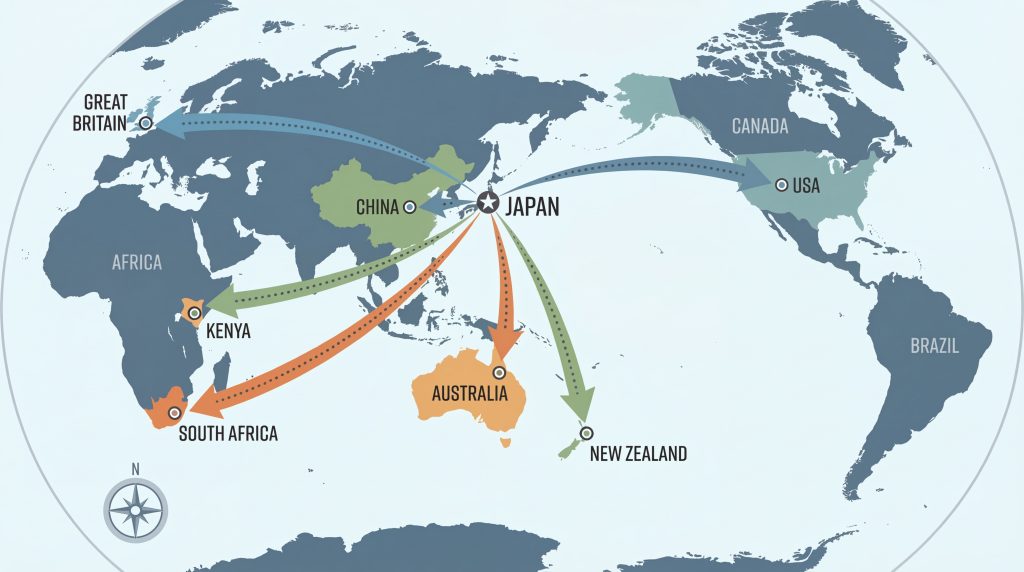
Buyers outside Japan — private buyers and overseas dealers alike — usually buy through a Japanese exporter with auction access. Japanese auto auctions are members-only wholesale markets: CAA, for example, describes its auctions as open to businesses such as used car dealers, franchised dealers and exporters, and only members can bid, on site or online. A member buys the car at auction and then sells it on to the customer.
Direct membership is designed for businesses operating in Japan, and each auction group sets its own requirements. USS, for example, requires a Japanese secondhand dealer’s license (古物商許可) for vehicles held for at least one year, permanent business premises in active use (for vehicle dealers, a display area or yard), registration as a qualified invoice issuer, at least two joint guarantors, and a ¥100,000 deposit when the membership contract is signed.
Sources: CAA, About Auto Auctions; USS, Membership Requirements. Checked 13 November 2026.
Tips for Buying from Japanese Car Auctions
- Understand the Auction Sheet before bidding. Check the grade, the body diagram and the inspector’s notes.
- Check whether you can import the car. Look up the rules for your destination before choosing a lot. For example, Kenya uses the year of first registration to determine a used car’s eligibility and requires a roadworthiness inspection in Japan before shipment.
- Check the exporter’s company details before paying. If you are dealing with a Japanese corporation, ask for its 13-digit corporate number. Use Japan’s National Tax Agency register to compare the company name and head office address with the details on your invoice.
- Confirm the shipping route and costs. Ask which Japanese port the car will leave from, which port it will arrive at and when the next sailing is expected. Find out whether roll-on/roll-off (RoRo) or container shipping is available for that route and which charges the freight quote covers.
- Set your maximum bid using recent auction results and your total budget. Ask your exporter for recent prices for the same model with a similar year, mileage and auction grade. USS members can look up historical auction prices. Before agreeing on a bid limit, allow for auction and exporter fees, transport to port, freight, insurance, and any duties, taxes and clearance costs at your destination.
Sources: Kenya Revenue Authority, Procedures for Motor Vehicle; Japan National Tax Agency, Corporate Number Publication Site; USS, Types of Auto Auction; USS, Steps in a USS Auto Auction. Checked 13 November 2026.
Written by DARIAL, Japanese car exporter since 2016.


