



- Introduction to Japanese Car Auctions
- How Japanese Car Auctions Work
- Major Japanese Car Auction Houses
- Regional Car Auctions Across Japan
- Types of Vehicles Sold at Japanese Auctions
- Why Japanese Car Auctions Are Trusted Worldwide
- Who Can Buy from Japanese Auctions
- Tips for Buying from Japanese Car Auctions
Introduction to Japanese Car Auctions
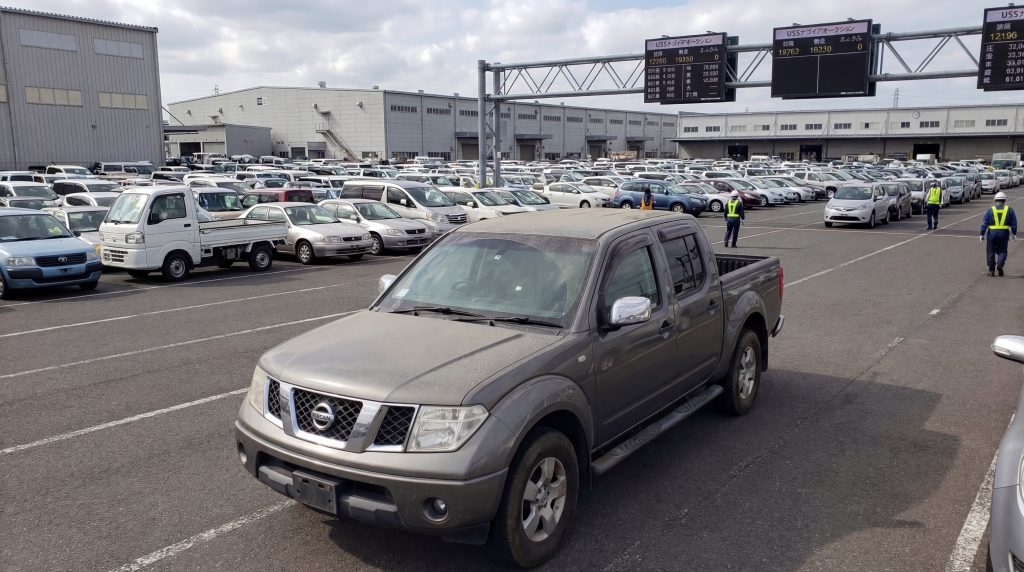
Japanese auto auctions in Japan are the primary marketplace for used vehicles, attracting dealers and exporters worldwide. These auctions are trusted sources of JDM (Japanese Domestic Market) used cars, where millions of vehicles are listed annually. For example, USS (the largest network) had 3.08 million vehicles listed and 1.98 million sold in 2023. Vehicles come from dealers, leasing companies, corporate fleets, and individuals.
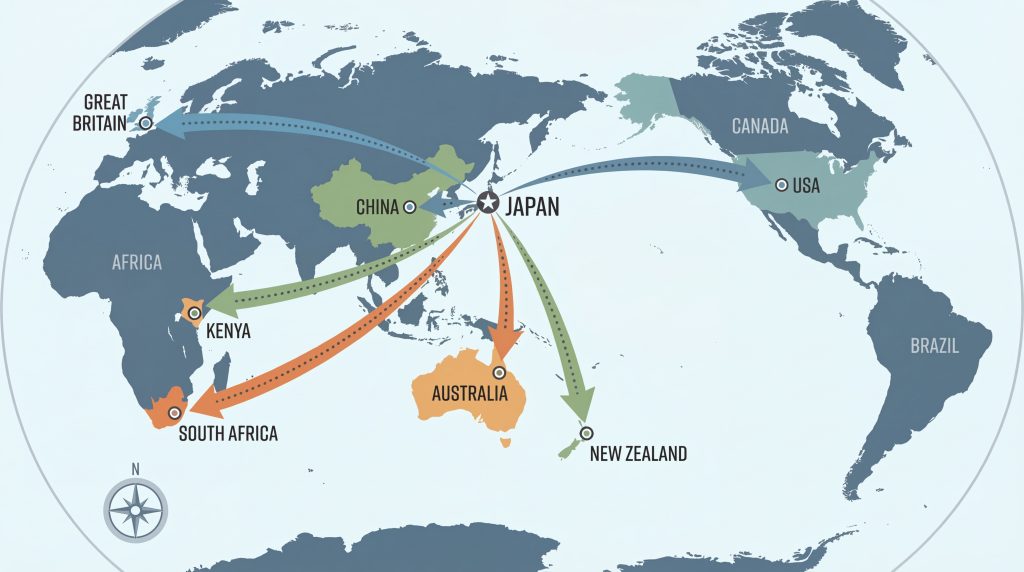
This vast selection – from compact kei-cars to luxury sedans and heavy trucks – makes auctions a go-to source for buyers in markets like South Africa, Kenya, the UK, Australia, and New Zealand. Auction reports (in English) detail each car’s condition, so international Japanese vehicle exporters can evaluate and bid on cars remotely. Overall, Japan’s auction system is a highly organized, competitive market that underpins the export of Japanese used cars worldwide.
How Japanese Car Auctions Work
Japanese car auctions are business-to-business markets (only dealers or licensed exporters can bid). Overseas buyers use a Japanese broker or exporter to access them. The process involves these steps:
Step 1: Vehicle Registration at the Auction
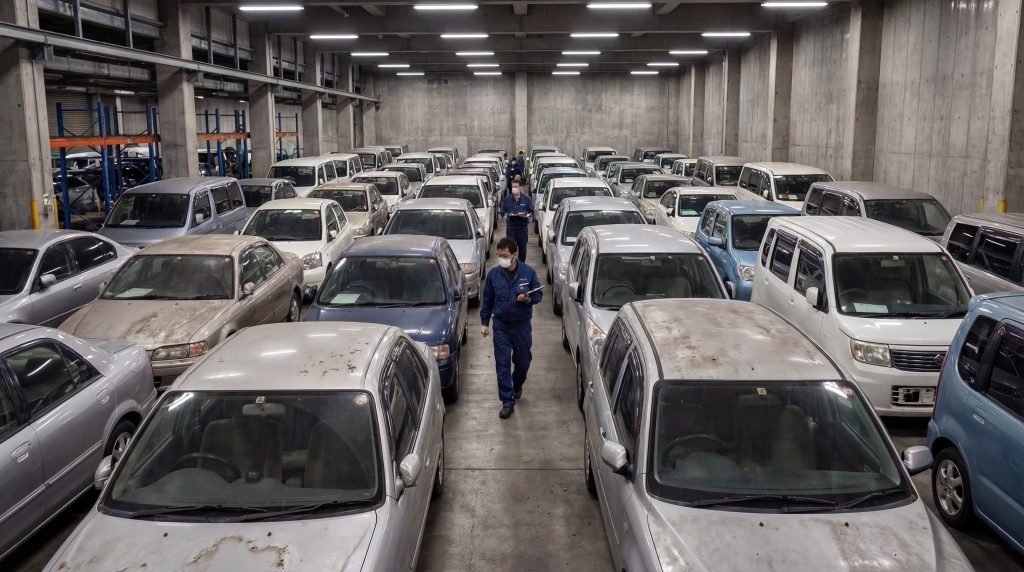
Sellers (dealers, rental/leasing companies, etc.) bring vehicles to an auction house and register them for sale. The auction staff verify ownership documents (vehicle title/logbook) and enter car details (make, model, year, VIN, etc.) into the system. Each vehicle is assigned a lot number and scheduled in a specific auction event. Sellers often pay a registration fee. By the time of auction, the car is parked on the lot or in a garage, ready for inspection. (No image here.)
Step 2: Professional Inspection and Auction Grading
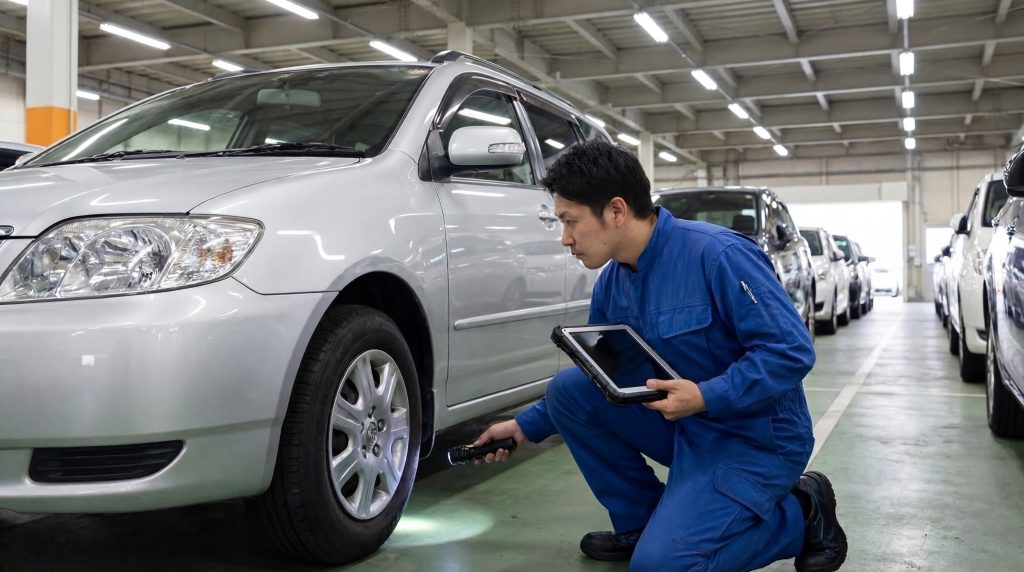
Before bidding begins, auction inspectors thoroughly examine each car. They check the exterior, interior, and mechanical parts. Any damage, rust, or repairs are noted. For instance, scratches or dents are marked on a diagram of the car. The inspector writes an auction sheet (condition report) in English, listing mileage, engine condition, and any known issues.
Each car also receives a grade (e.g., 5, 4.5, 4, R, etc.), where higher grades mean better condition. Japan auctions like TAA use very strict grading. This transparent grading and the included photos allow buyers to judge the car’s quality remotely before bidding.
Step 3: Auction Listing and Vehicle Catalog
The inspected vehicles are listed in the auction catalog (often online for member access). Each listing shows key details: model, year, mileage, auction grade, and any special notes (e.g. “repair needed” or “accident damage”). Multiple photos (exterior and interior) accompany the listing, along with the seller’s minimum price or reserve. In modern auctions like USS or TAA, the catalogs are fully digital.
Dealers and exporters can search these online auction sites by keywords or filters (e.g., “Honda Fit”, “Right-hand drive”). Detailed auction sheets ensure that buyers know exactly what’s being auctioned, and they can compare many cars before bidding.
Step 4: Bidding Process at Japanese Auctions
At auction time, each car is brought into the bidding lane (or display area). Auctions run like a fast-paced sale: an auctioneer announces the car, and registered bidders place bids. In many venues, this is done via computer terminals or paddle-raising; online platforms allow remote bidding in real time.
The auction system tracks bids against the reserve price. If the highest bid meets or exceeds the reserve, the car is sold to that bidder. If not, the car is “passed” (unsold) and may be re-auctioned later. This competitive bidding ensures fair pricing: buyers set their limits in advance to avoid overpaying, and the highest genuine offer wins. (No public access is allowed; only licensed members bid.)
Step 5: Winning the Auction and Payment
Once you win a bid, you must pay the hammer price plus any fees (often within 1–3 business days). The auction house issues a purchase invoice or sales certificate to the buyer (exporter). This document, along with the car’s original registration (logbook), is needed to export the vehicle. Some auctions may require a deposit before bidding, and the balance after winning.
After payment, the car can be removed from the auction yard. (Often, the exporter arranges transport to the port at this stage.) Officially, ownership is transferred after payment. For example, USS requires payment within the stipulated deadline and then issues a “Slip” to release the vehicle. This completes the auction purchase, and export arrangements can proceed.
Step 6: Export Preparation and Shipping
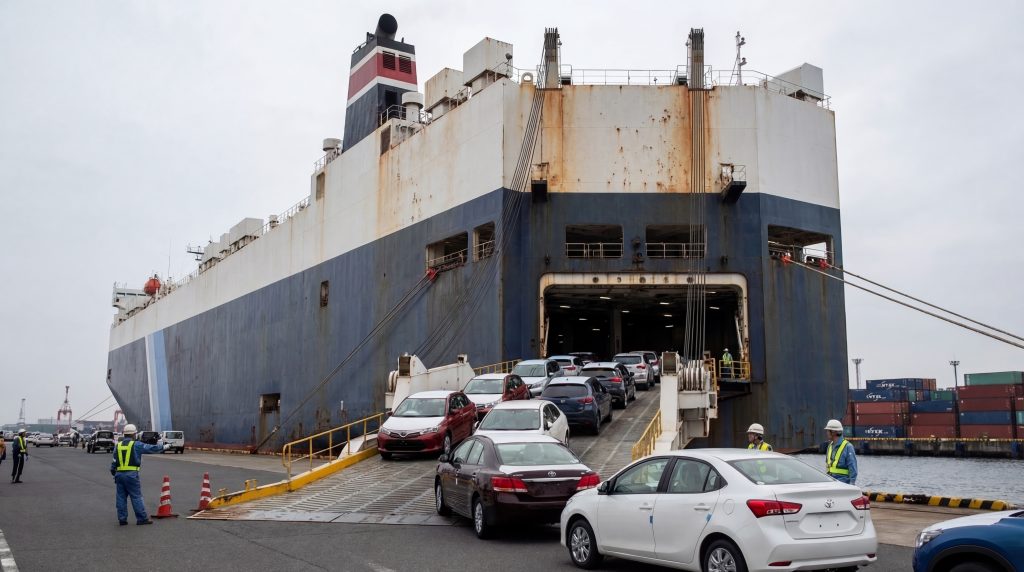
After purchase, the exporter prepares the car for shipping. This involves deregistering the car in Japan (obtaining the Japanese deregistration certificate and export documents) and handling any safety inspections for export (e.g. JEVIC). The car is then either driven onto a Roll-on/Roll-off (RoRo) vessel or loaded into a shipping container. RoRo is common for standard vehicles and is cost-effective; containers are used for extra protection or special loads.
Transit time depends on the destination (e.g., ~3–4 weeks to Africa, ~30 days to Europe or Australia). The exporter also arranges insurance. Once the vehicle arrives at an international port (e.g. Durban for South Africa, Mombasa for East Africa, Southampton for the UK, Auckland for NZ), local customs clearance and import procedures take over. Throughout the process, the auction-winning document and invoice serve as proof of ownership and value.
Major Japanese Car Auction Houses
Japan has many auction networks. Key players include:
USS Auctions
USS (Used car System Solutions) is the largest auction group in Japan, operating ~19 venues nationwide. In FY2023, USS listed 3.08 million vehicles and sold 1.98 million (a ~39.6% market share). USS auctions run weekly across Japan (e.g., USS Tokyo in Chiba, USS Nagoya, USS Osaka).
It offers both live and satellite/online bidding. USS requires dealer or exporter membership (no public bidding). Because of its scale, USS venues have a huge variety of cars—from economy to luxury—making it popular among exporters.
TAA (Toyota Auto Auction)
TAA is Toyota’s in-house auction network, with 16 venues across Japan. Established in 1967 (the first auto auction in Japan), TAA is known for its rigorous inspections and high standards. Many vehicles come from Toyota dealers, so quality tends to be very good. TAA’s grading system is particularly strict.
Auctions are held weekly (mostly Tuesdays/Thursdays, plus some Saturdays) at locations like Yokohama (Kanagawa), Kinki (Hyogo), and Hokkaido. TAA venues are often near ports, which helps exporters. TAA works with CAA (Chubu Auto Auction) on shared online bidding (TC-webΣ).
JU Auctions (Japan Used Car Dealers Association)
The JU Group consists of many regional auction houses (66 venues nationwide). Operated by the Japan Used Car Dealers Association, JU auctions have over 1 million transactions annually. They are spread across Japan, from Hokkaido down to Okinawa. Each JU location has its own focus (e.g., JU Tokyo for quality cars, JU Hokkaido for reliable diesel 4x4s).
The JU network offers a massive selection and competitive prices. Like others, JU auctions require membership. Provide Cars notes that different JU venues cater to different needs (vans, trucks, 4WD, etc.), so buyers can find nearly any vehicle.
ARAI Auction Group
ARAI Auction specializes in trucks, construction machinery, and specialized equipment, though they also sell regular cars and vans. It was founded in 1992 and has multiple venues (e.g., in Sendai, Nagoya, and Osaka). ARAI auctions are held frequently (various vehicles on different weekdays).
They use advanced tech: all cars get high-definition 4K photos and engine videos so buyers can inspect remotely. ARAI’s focus on trucks and heavy equipment makes it a go-to for commercial buyers from overseas seeking work vehicles.
CAA (Chubu Auto Auction)
CAA is a large auction mainly in central Japan. Founded in 1987, it operates four main venues: Chubu (Toyota City), Tokyo (Kashiwa), Gifu, and Tohoku (Iwate). It merged systems with TAA in 2005 to unify membership. CAA auctions emphasize strict quality control; they only list vehicles that pass rigorous inspections.
For example, CAA Chubu in Nagoya supports ~400,000 cars listed annually. The Chubu venue alone has 1,150 seats and huge daily auctions (often near the Nagoya port). Buyers know CAA cars are durable and high-quality.
Honda Auto Auction (HAA)
HAA is the auction network run by Honda. Established in 1992, it has six venues nationwide (Tokyo, Nagoya, Kansai, Sendai, Hokkaido, Kyushu). Only Honda dealers can list, so nearly all cars are Honda models (mostly trade-ins). This ensures a reliable supply of relatively new, well-maintained Hondas.
All HAA venues operate under the same standards, and cars are inspected by third parties (AIS) to guarantee transparency. Honda auctions are popular for their high closure rate and strict grading. Like other auctions, membership is required, and real-time online bidding is available nationwide.
Nissan Auto Auction (NAA)
NAA is the Nissan dealers’ auction group. It runs multiple venues in cities like Yokohama, Nagoya, Osaka, and Fukuoka. About 85% of NAA’s listings come directly from Nissan dealerships, offering a steady supply of quality used Nissans (from Leaf EVs to SUVs).
Each listing includes many interior/exterior photos and sometimes 360° views, making the condition easy to verify. NAA also has “special corners” (e.g., one-owner cars, near-new cars with warranties) to aid buyers. Overall, NAA auctions are trusted for their focus on Nissan-brand quality vehicles.
Regional Car Auctions Across Japan
Japan’s auctions are spread nationwide, catering to different regions:
- Tokyo and Eastern Japan (Kanto/Tokyo Area): This region includes USS Tokyo (in Noda, Chiba) – one of the largest single venues (site area ~11 Tokyo Domes. Other nearby auctions include TAA Kanto (Yokohama) and CAA Tokyo (Kashiwa, Chiba). Many JU auctions (Tokyo, Saitama) also operate here. Because it’s near the capital, this area sees a huge volume of vehicles, especially compact cars and light vans.
- Central Japan (Chubu/Kansai): The Chubu area (around Nagoya) is home to USS Nagoya (the first USS location) and CAA Chubu (Toyota City). CAA Chubu handles ~400k listings/year. In Kansai (Osaka/Kobe), there are USS Osaka and TAA Kansai (Hyogo), as well as CAA Kansai (Osaka). These auctions often feature many corporate vehicles, minivans, and trucks – popular exports to South Africa, Zambia, etc.
- Western Japan: Includes auctions near Hiroshima (TAA Hiroshima) and southwestern Japan. Many national auctions attract participants from west Japan via simultaneous bidding systems. Exporters often consolidate shipments from west ports (Kobe, Osaka).
- Northern Japan (Hokkaido/Tohoku): Hokkaido has JU Sapporo and HAA Hokkaido venues, plus TAA Hokkaido (Sapporo). The snowy north produces trucks and 4WD vehicles (like Toyota Hilux, Land Cruiser) which are exported widely. JU Aomori and JU Sendai serve the Tohoku region. Often these northern auctions list older cars that comply with stricter emissions rules (hence many diesels).
In each region, auctions run almost daily (except Sundays) and attract local dealers and exporters. The widespread network means buyers anywhere can find a match: from kei-cars in Sapporo to heavy trucks in Nagoya.
Types of Vehicles Sold at Japanese Auctions
Auctions in Japan handle almost every vehicle type. Common categories include:
- Passenger Cars and SUVs: The largest share. Popular export models include Toyota Corolla, Honda Fit, Nissan Sylphy (sedans); Toyota RAV4, Honda CR-V (crossovers); and numerous Kei cars (tiny city cars unique to Japan). Many family sedans and hatchbacks are sourced from auctions for markets like the UK and Australia.
- Commercial Vehicles and Vans: Light commercial vans (e.g. Toyota Hiace, Nissan Caravan) and small trucks (Daihatsu Hijet, Suzuki Carry) are frequently listed. These are popular in African and Pacific markets where utilitarian vehicles are needed. Auction houses often have dedicated sections for work vehicles.
- Trucks and Heavy Equipment: Japan auctions sell heavy trucks (tractor units, dump trucks), construction machinery (excavators, loaders), and agricultural equipment. ARAI Auction is especially known for machinery auctions. Buyers for African mining or construction industries often look to these auctions for heavy-duty vehicles.
- Motorcycles: There are specialized motorcycle auctions (e.g. USS Motorcycle Auction, Iruka Auction). They feature popular bikes from Honda, Yamaha, Kawasaki, Suzuki, etc. Motorcycles in good condition can be exported (e.g. to Australia, UK) at competitive prices. (Note: motorcycle auctions follow similar grading/inspection practices.)
- Specialty Vehicles: Auctions also list buses, forklifts, and even boat engines or parts. Some auctions like ZIP focus on imports (European cars, etc.). In general, buyers can find anything from a family sedan to a commercial forklift in these markets.
Why Japanese Car Auctions Are Trusted Worldwide
Several factors make Japan auctions highly regarded:
- Transparent Inspection System: Every car undergoes a detailed multi-point inspection by certified professionals (or third-party firms like JEVIC/AIS). Auction sheets clearly document all flaws and the overall condition. Buyers know exactly what they’re bidding on. For example, TAA’s thorough grading system is praised for its reliability.
- Huge Vehicle Selection: With auctions listing millions of vehicles each year (USS alone had 3.08M listings in 2023), there is an enormous variety. This competition among sellers keeps prices fair and allows buyers to find rare models or specific configurations. Even small domestic vehicles (kei-cars) or niche items (diesel SUVs) are readily available.
- Competitive Pricing: Because many dealers bid, auctions often yield realistic market prices. A popular model may start at a low base, and bidding drives it up to its true value. The transparent, open bidding process ensures you pay roughly the same as other importers. Many buyers compare prices across different auctions (USS, TAA, CAA, etc.) to find the best deal.
- Reputation and Regulation: Auction houses are run by established companies (Toyota, Honda, dealer associations) under strict rules. They operate B2B, ensuring professional participants only. Moreover, exporters often belong to JUMVEA (Japan Used Motor Vehicle Exporters Association), which upholds fair trade. Together, this ecosystem builds trust that what’s listed is what’s delivered.
Who Can Buy from Japanese Auctions
Japanese auto auctions are not open to the public. Only licensed dealers, auction members, and commercial companies can participate directly. These members must register and meet strict criteria (bond, showroom, etc.). For international buyers (in South Africa, UK, Australia, etc.), the usual approach is to work with a Japanese car exporter or auction agent, company such as Darial.
These professionals hold auction memberships and bid on your behalf. They handle the paperwork, bidding, and export procedures. Notably, many reputable exporters are members of JUMVEA, ensuring they adhere to ethical export standards. In short, overseas buyers gain access to auctions via local brokers: you find the car and the dealer/expert takes care of connecting to the auction.
Tips for Buying from Japanese Car Auctions
- Understand the Auction Sheet: Learn to read the grading diagram, inspection notes, and grade on the sheet. A grade “3” or “4” is typically clean; “R” means rear damage; “S” or “W” means accident or water damage. Photos and annotations are crucial. If unsure, ask your exporter to clarify any marks or request more pictures/videos.
- Set a Smart Bidding Budget: Include all costs (auction price, shipping, import duties, taxes) in your budget. Decide your maximum bid before the auction. It’s easy to get caught in a bidding war; stick to your limit to avoid overpaying.
- Choose Reliable Export Partners: Only deal with licensed Japanese used car exporters. Check if they are members of JUMVEA or JUMVEA-approved. They should provide transparent fees (no hidden charges). Read reviews or get references. A good exporter will also help with post-arrival support (deregistration, customs clearance) in your country.
- Check Port and Logistics: Know which Japanese port will ship to your country (e.g. Nagoya for Australasia, Yokohama/Tokyo for Europe, Osaka/Kobe for Africa). Your agent should quote shipping options (RORO vs container) and transit times.
- Stay Informed on Market Trends: Auction prices fluctuate by season and demand. Follow forums or blogs for insights. For instance, SUVs may be cheaper in winter months when demand dips. Your exporter often has market data on recent auction results.
By following these steps and tips—and understanding how Japan’s auction system works—you can successfully purchase high-quality used Japanese vehicles for export to South Africa, Tanzania, Zambia, Kenya, the UK, Uganda, New Zealand, Australia, or any other market.


